Daily Archives: November 5, 2026

11 posts

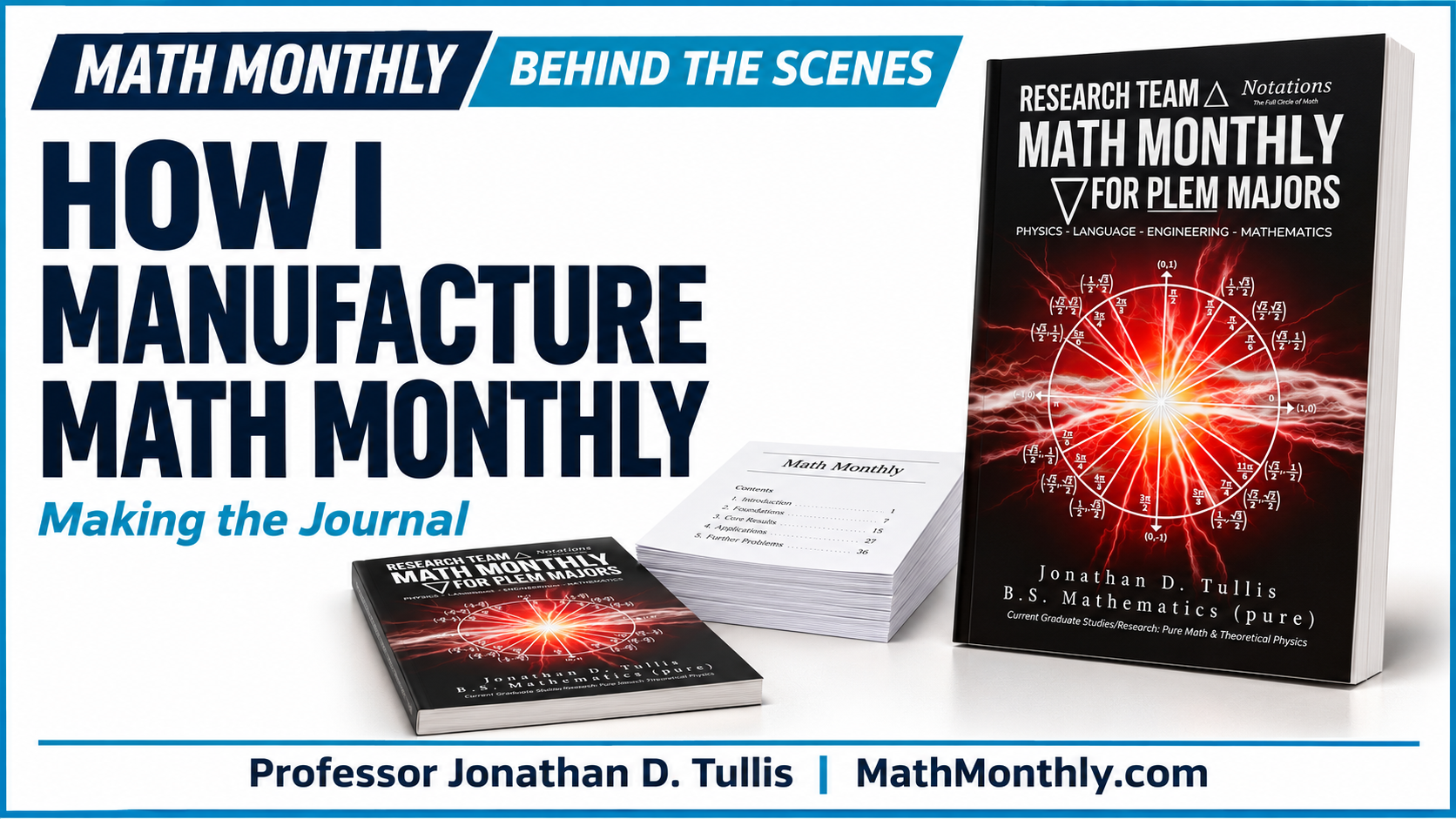
This Is How I Manufacture the Math Monthly Journal

Math Monthly — Behind the Scenes This Is How I Manufacture the Math Monthly Journal Watch Professor Jonathan D. Tullis assemble the first physical prototype of the Math Monthly journal. From scoring the cover and preparing the adhesive to thermal binding, trimming, and making a laminated bookmark, this video follows […]

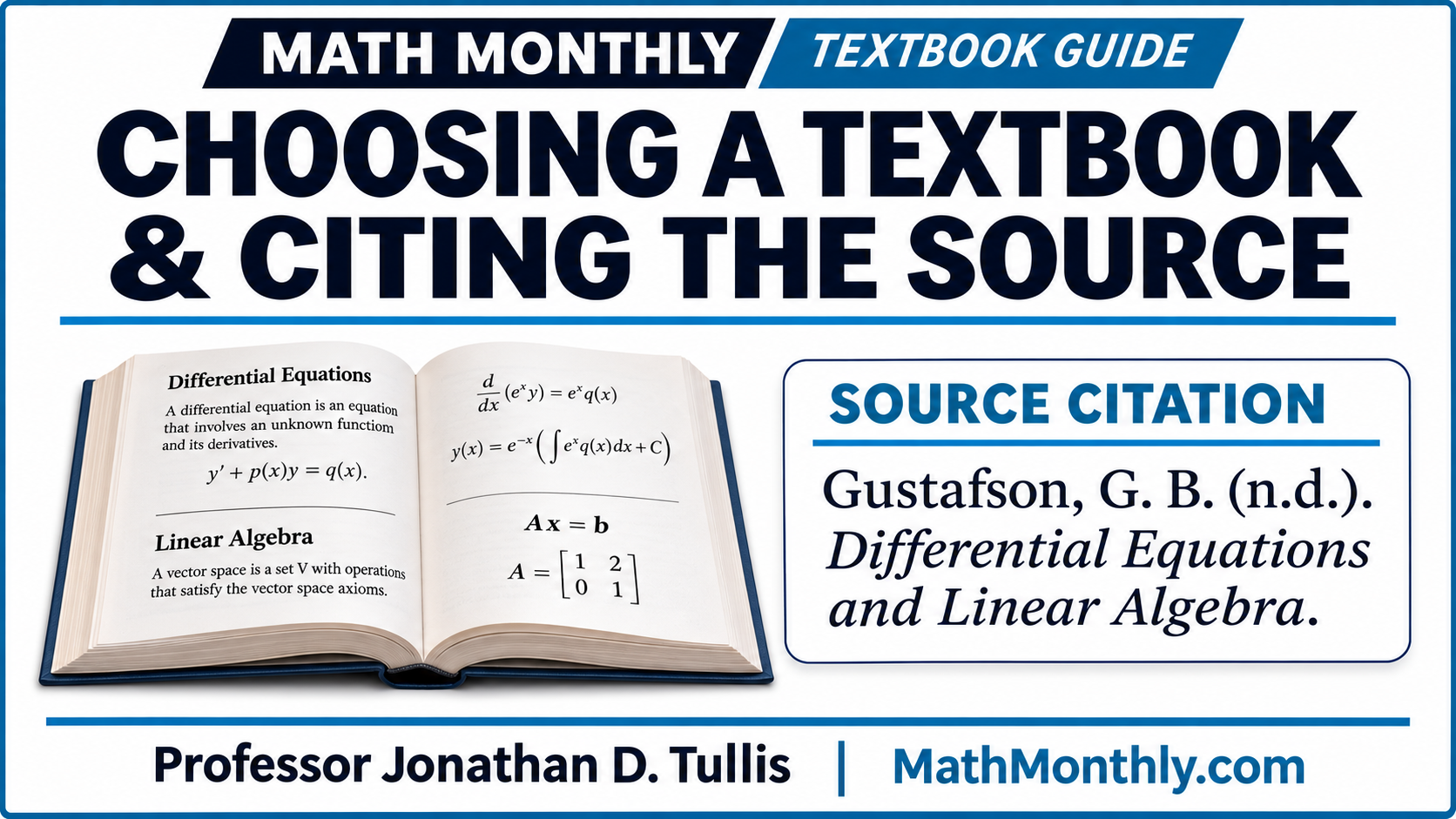
Choosing a Textbook and Citing the Source

Math Monthly — Research Preparation Choosing a Textbook and Citing the Source Follow Professor Jonathan D. Tullis as he selects a textbook for exploration and introduces the next step: citing the source. This brief Math Monthly clip captures the beginning of the research process. Watch this video on YouTube ↗ […]

The Ultimate Crash Course for STEM Majors (PDF Download)

Math Monthly — Inside the Book

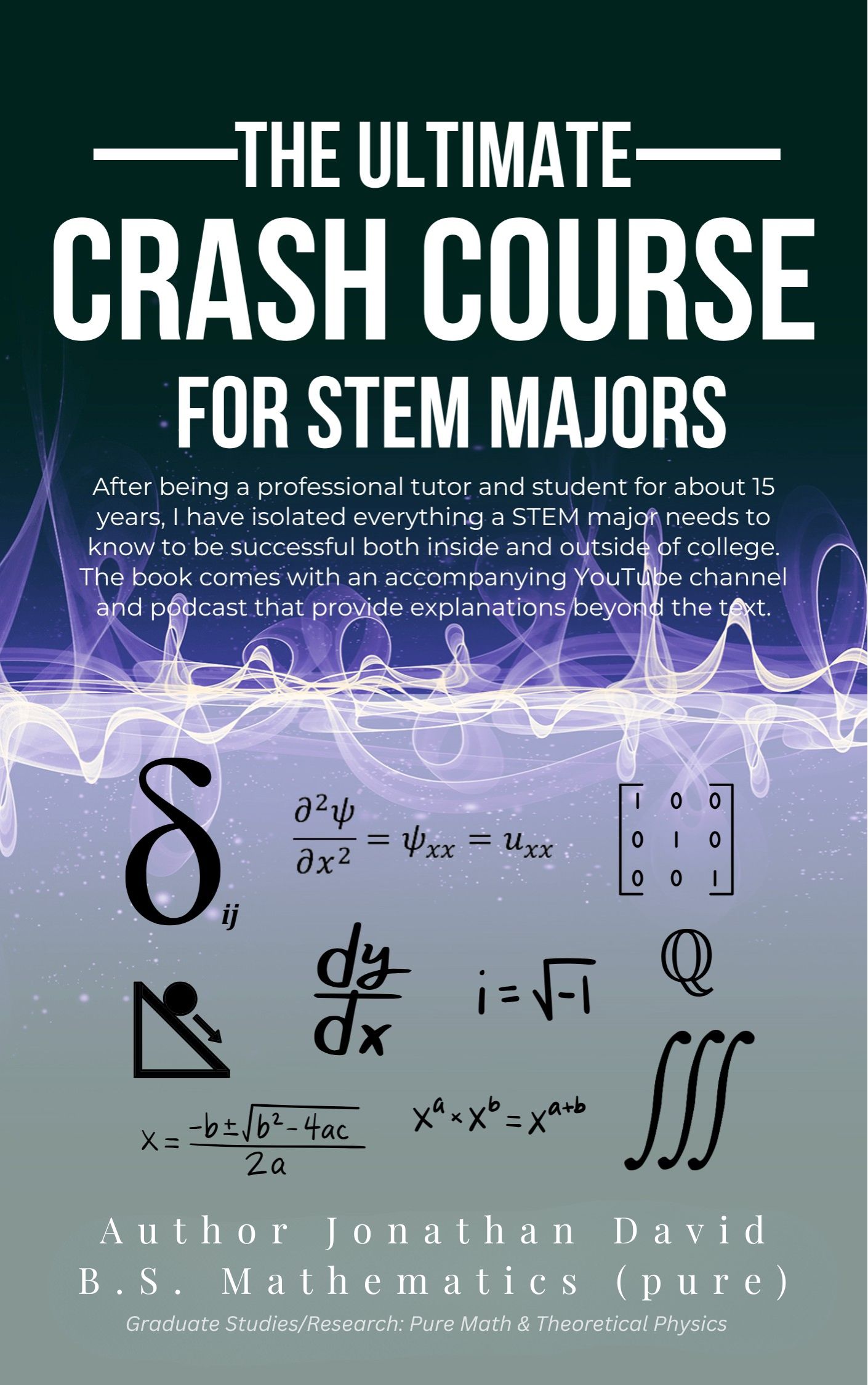
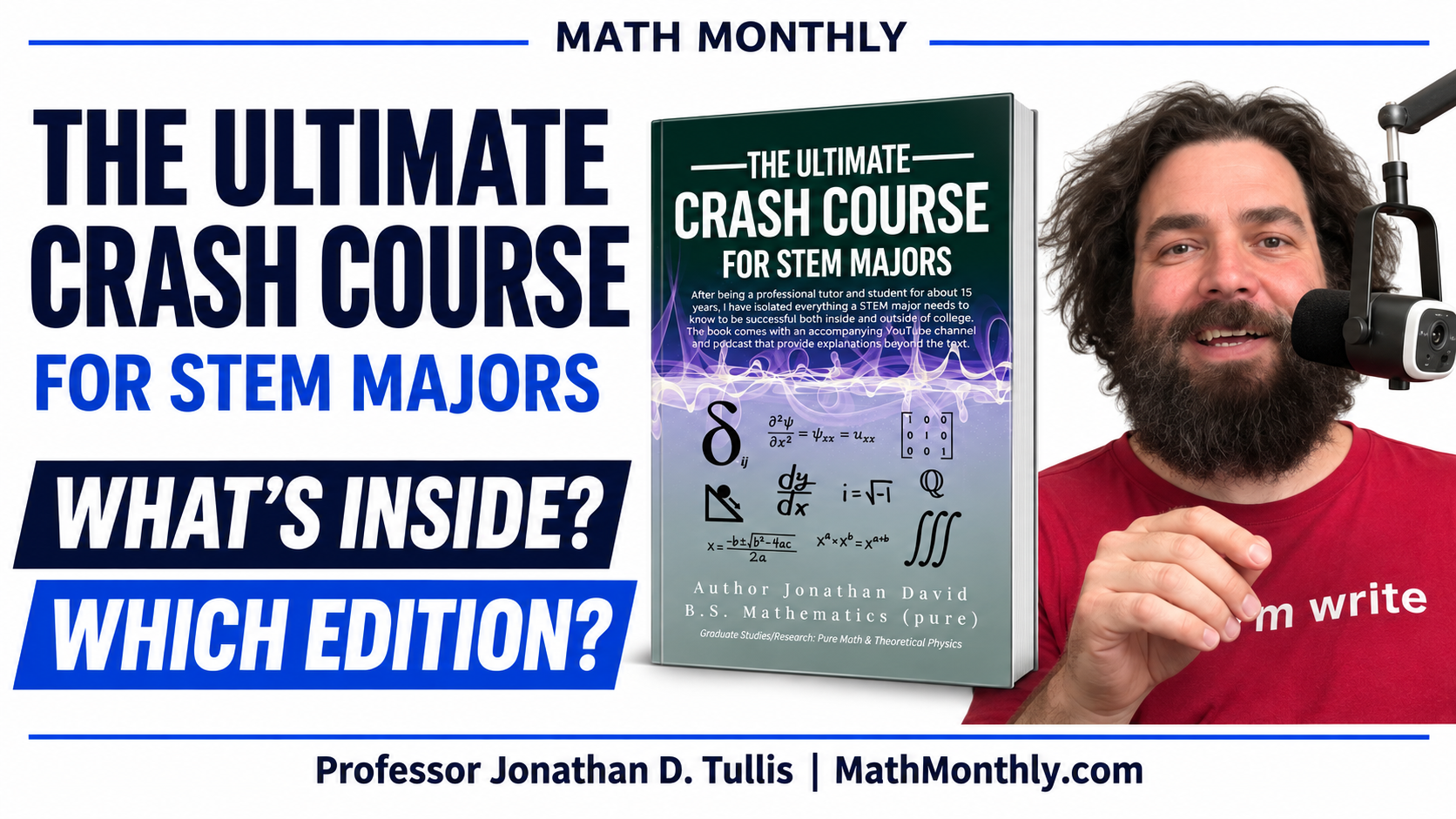
Inside The Ultimate Crash Course for STEM Majors — Algebra, Calculus & Beyond

Take a look inside The Ultimate Crash Course for STEM Majors with Author Jonathan David. This walkthrough previews the algebra review, detailed calculus solutions, and introductory material on vectors, physics, linear algebra, differential equations, and index notation.


Watch the inside-the-book preview on YouTube ↗

See the Explanations, Calculations & Written Solutions

Jonathan demonstrates the book’s student-oriented presentation and compares it with the more formal layout of his mathematical journals.

  • Review algebraic manipulation, exponential expressions, and notation.
  • Preview calculus examples through sequences and series.
  • Explore introductory vector calculus, physics, and index notation.
  • See the accompanying library of recordings showing the books being written.

Original Transcript (punctuated)

Based on the supplied transcript. Punctuation and paragraph breaks have been added, with repeated fillers and false starts reduced for readability. Obvious transcription errors have been corrected, and unclear speech is marked where necessary. The speaker’s opinions and product descriptions are retained.

Okay, boys and girls. This is going to be a look inside The Ultimate Crash Course for STEM Majors that I wrote.

Let me show you: if you buy the Triple Play, it comes with access to upward of 900 or 1,000 videos of me writing the book.

Let’s go from oldest to newest. You can look back at when I started this mission to get you to change your ways.

As you go through it, you’ll find videos of me writing the books and going through the textbook. There are something like a thousand videos here. It doesn’t tell me the count, but there’s a lot.

You can type in whatever—[unclear speech]—and see what comes up. Here’s me adding a section to the book, a recap of a live tutoring session. That was a live session I did.

There are lots of videos of me writing this book, and they’re included if you purchase the Triple Play. It’s $99.

This is about 400 pages. It contains a plethora of information that is world-class, written from your point of view.

First, I give you a preview of what you need from algebra. Then I went through James Stewart’s calculus book, used the outline, took a question from every section, and answered it.

It follows the same general material as Stewart’s Calculus or Thomas’ Calculus. I cover the situations, but I didn’t just take easy problems.

I chose questions that cover what you need and include the tricks students miss because they skip lecture, use AI and Khan Academy, and don’t do the research.

That’s why I wrote this: to help repair the damage that Khan Academy, AI, Wyzant tutoring, and teacher solution manuals did to your education.

It isn’t necessarily for someone currently in calculus, although it could be beneficial. It would be a violation of your syllabus, just so you know.

The way I look at it, if you need help after Calculus Two, you’re in the wrong place. Physics, math, and engineering aren’t for you if you need assistance after Calculus Two.

I used that stuff in Calculus One and Two, too. Then I tutored for 15 years, and I know because I watched students fail. I’m not making it up.

Here, I show how to take notes from a physics book. The How to Study guide is in here. I show that material, then get into solution writing.

I show simple algebraic things students miss, including notation they misunderstand, before starting calculus.

There isn’t much you need from algebra or trigonometry before calculus. I put the arithmetic you need here, show how to do it, then move on.

The problems demonstrate tedious arithmetic because you’ll do that kind of work in calculus, along with much more. It becomes increasingly tedious as you progress into mathematics.

I prepare you by reviewing what you need from algebra. Here’s exponential material. I choose the craziest examples and show how to solve them.

We’re still in the algebra section. Let me jump to calculus. There are some linear algebra things, more material, and here we are at limits.

My journals are written differently, very professionally. This is written as you would write it as a student, not like a professional scholarly paper. That’s why I wrote it this way.

It’s more of a centered arrangement instead of an elegant page filled from corner to corner. Let me show you the difference.

Some people are confused about why the book is written this way. Look at this other one. It’s structured differently.

That’s something we do together as a group, with a lot of information I’m pointing out. I fill the pages as much as I can, top to bottom and left to right.

In this book, I write the way you think as a student. I worked one-on-one with students for 15 years and wrote it the way you think.

The calculus material goes through sequences and series. I show how to do the questions you’ll see in calculus exams.

I didn’t write it to help you cheat. I wrote it to show what you’re missing. I took the questions I’d seen on exams and solved them in detail from your perspective.

There’s a lot of integration material, the squeeze theorem, and more. Then we get into physics and vector calculus.

If you’re in Calculus Two doing sequences and series, the material you need is in this book. It’ll save your life. It’s worth purchasing and inexpensive.

I drastically reduced the price, and it comes with the videos because I’m moving on to the journal.

For $99, you get all my work, all my books, and the videos at the website I showed you. It’s a one-time fee.

Here’s where I introduce engineers and physicists to tensor index notation before tensor analysis.

I show the backbone because textbooks don’t always show the proofs behind these objects or why they work. They give you the objects, and you think, “What is this, and why does it work that way?”

I show that here. For example, the cross product: physics and engineering books may give you an expression without all the background.

I show the proofs and how it happened, on a basic scale rather than in a super-intense way.

Then I get into physics problem-solving. There’s written explanation, and I show vector addition properly.

I introduce physics, vector calculus, linear algebra, differential equations, and higher math because, if you need help after Calculus Two, you’re in the wrong place.

This is The Ultimate Crash Course. Check it out. It’s a great book and resource. I highly recommend it.

If you read ratings from kids, remember that I tell them to stop cheating, lying, and stealing, and they go destroy my business. They’re going to burn in hell. They’re sick.

Don’t believe the things you read online. This is the book. You can see it here and watch the videos of me writing it live. It’s quality material.

Have a nice day.

AI Summarization

Author Jonathan David provides a screen-recorded preview of The Ultimate Crash Course for STEM Majors and its accompanying lesson library. He explains the organization, choice of examples, and deliberate use of a student-oriented writing style.

Algebra Review Before Calculus

The walkthrough begins with algebraic manipulation, exponential expressions, and notation. Jonathan describes choosing examples that expose common misunderstandings and prepare readers for lengthy calculations in later coursework.

Calculus Through Sequences & Series

Jonathan describes using the section progression of James Stewart’s calculus textbook to organize worked examples. The preview includes limits, integration, sequences and series, and problems selected for details students frequently overlook.

A Student-Oriented Presentation

The book’s layout and explanations are intended to resemble a student’s detailed working notes. Jonathan contrasts this presentation with the more formal, densely arranged pages of his collaborative mathematical journals.

Introductions to Later Topics

Later material introduces vector calculus, linear algebra, differential equations, physics problem-solving, and index notation. Cross products and vector addition are mentioned as examples where the book explores the reasoning behind expressions and procedures.

Recordings of the Writing Process

Jonathan also demonstrates the accompanying library, describing hundreds of recordings of the books being written and textbook material being explored. He notes that he does not have an exact count of the videos.

The price and bundle contents mentioned in the recording reflect the offer described at that time. Consult the linked product pages for purchase details. Whether a supplementary resource is permitted in a course depends on that course’s instructions.

Books, PDF Bundle & Lesson Library

Explore my books and PDF bundle, which include access to a library of lessons.

Hardcover purchasers: Send me your purchase receipt to receive lesson library access.

Continue Exploring with Math Monthly

Explore mathematics, physics, and their connections to engineering with Author Jonathan David. Discover the available Math Monthly memberships and follow the development of new lessons and journal material.


View Math Monthly Memberships ↗

Membership Required

You must be a member to access this content.

View Membership Levels

Already a member? Log in here

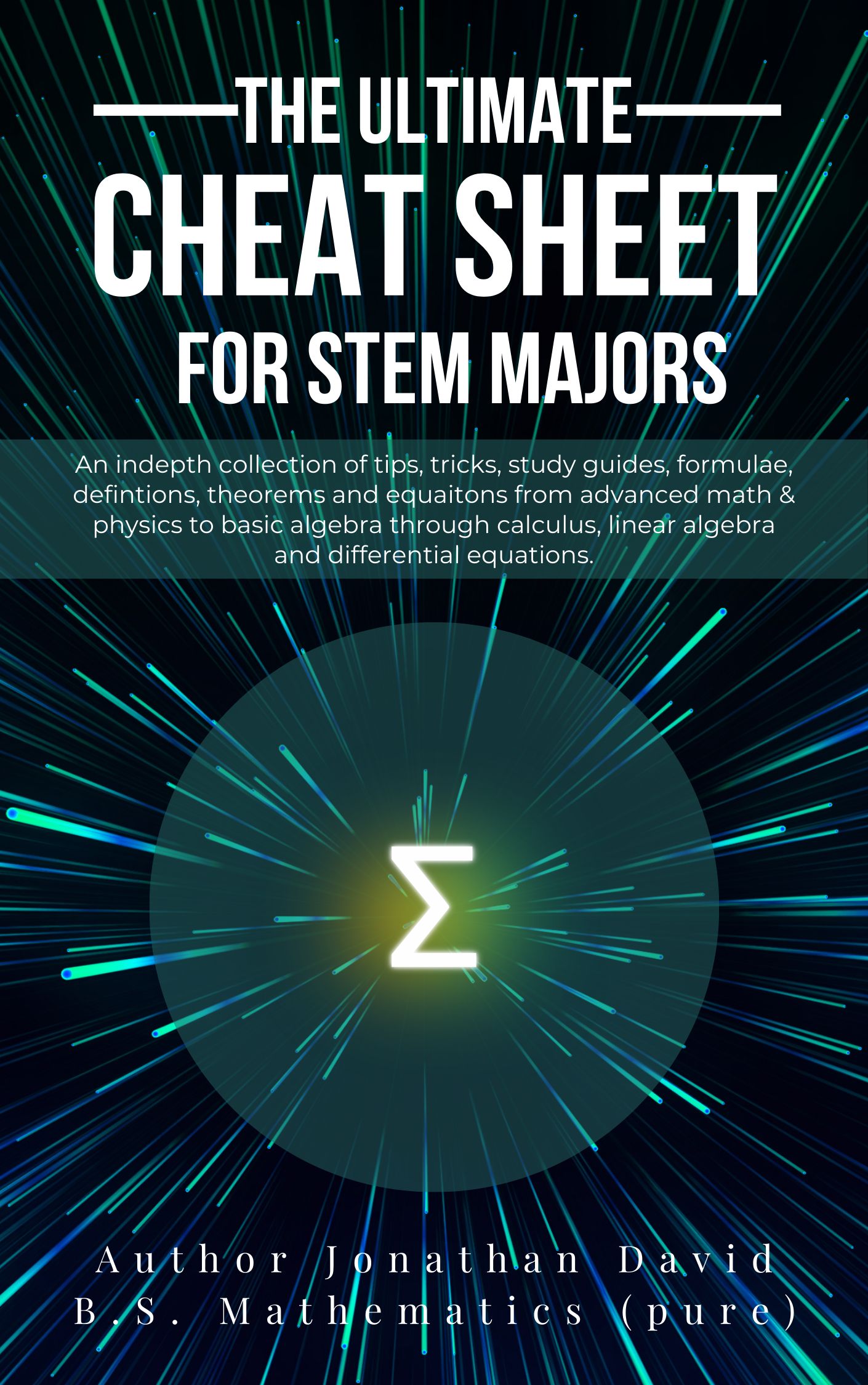
The Ultimate Cheat Sheets for STEM Majors (PDF Download)

Math Monthly — Inside the Book

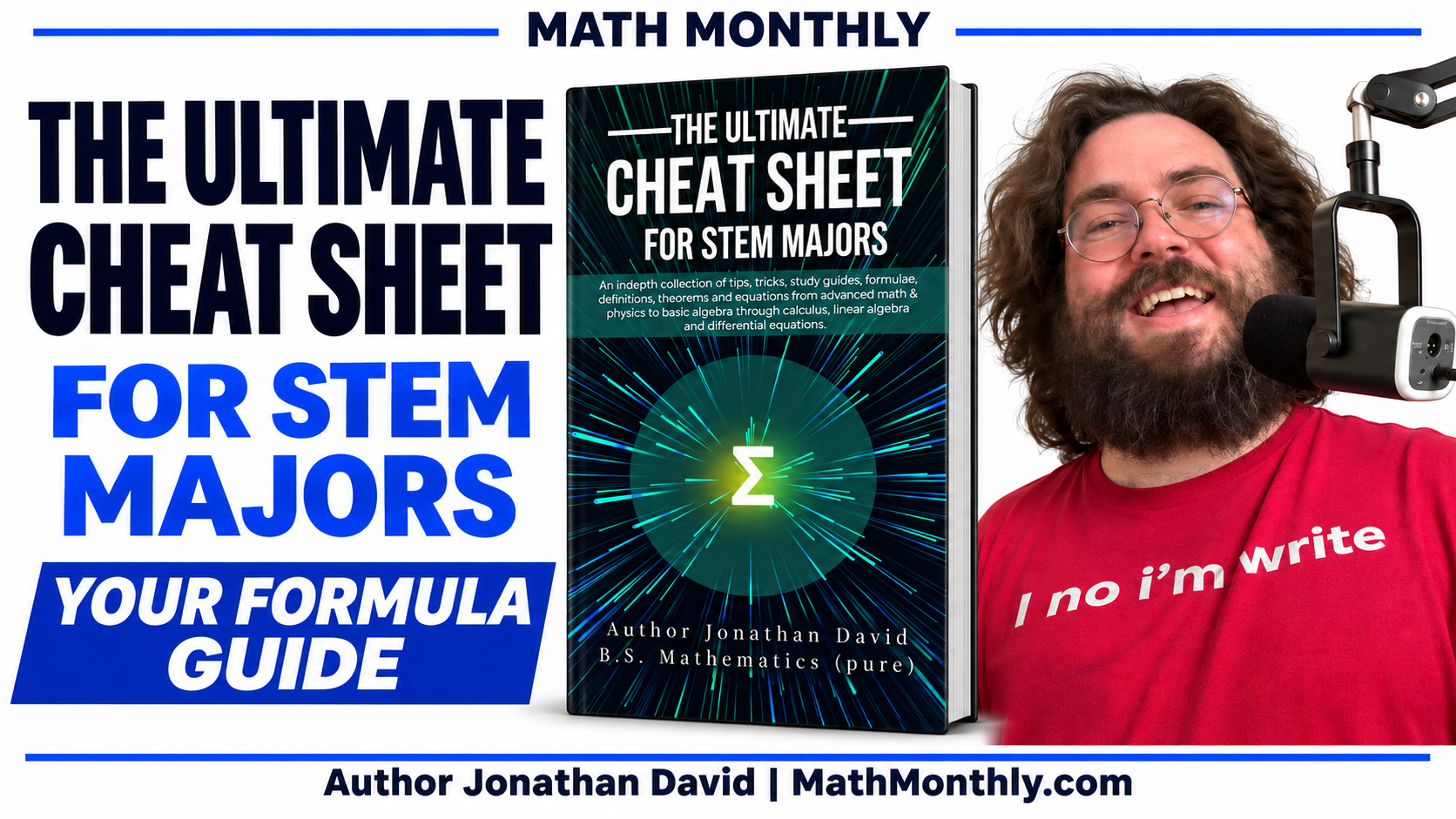
Inside The Ultimate Cheat Sheet — Math Formulas, Tips, and Worked Examples

Take a look inside The Ultimate Cheat Sheet with Author Jonathan David. This walkthrough previews the subject-by-subject formula guides, explanations, and worked examples covering algebra, trigonometry, calculus, differential equations, linear algebra, and basic physics.


Watch the inside-the-book preview on YouTube ↗

Explore the Collection by Subject

Jonathan opens the individual subject guides and explains how their student-oriented presentation differs from the more formal writing in the Math Monthly journal.

  • Algebra and trigonometry formulas and reminders.
  • Differential, integral, and multivariable calculus material.
  • Common difficulties in differential equations and linear algebra.
  • Explanations, tips, and accompanying recordings of the writing process.

Original Transcript (punctuated)

Based on the supplied transcript. Punctuation and paragraph breaks have been added, with repeated fillers and false starts reduced for readability. Obvious transcription errors have been corrected, and unclear speech is marked where necessary.

All right, little boys and girls. I’m going to show you my Ultimate Cheat Sheet.

By the way, these are all the books you get in the Triple Play bundle. I’m going to find the one that has all the subjects in it. Where is it? Is it not here? I might have it in the other one.

Basic physics, linear algebra, one, two, three, four, five, Quartic Play, Math Monthly Edition One, How to Study in College. Where’s the full book? I must not have added it. I’ll have to add it.

That’s okay. We’ll look at all of them: college algebra, trigonometry, differential calculus, integral calculus, several-variable or multivariable calculus, differential equations, linear algebra, basic physics, and How to Study.

How to Study is the first book in the collection. I had them consolidated. You can open Adobe and consolidate them if you want. I didn’t realize I hadn’t put the combined version in there. I’ll find it and add it.

I’ll cover the How to Study guide in another video because that’s also a book people often buy separately.

I’ll show you these, starting with algebra. Look at how the covers have evolved. My cover-making skills have evolved over the years.

If you purchase the Triple Play bundle for $99, you get a lifetime access code to these videos on my website.

There are about 900 to 1,000 videos, something like that: 200 to 300 podcasts and 600 to 700 videos of me writing the books.

You can type in “limits,” or whatever you’re looking for. Most of them show me writing these books.

Here’s one of me writing the book. For those saying, “You used AI”—“Mom, Sunny D!”—here’s the video of me writing a freaking book, you little twerp. Okay, God.

This is what it looks like. The cheat sheet books are really formula books. It isn’t a cheat sheet so much as a list of formulas.

I put together what you’re supposed to have in your brain. You’re supposed to memorize this through doing problems repeatedly. This is just the algebra book.

Here’s the calculus collection, including different limit situations, integrals, and integration material.

Several-variable calculus is the same idea, with several variables. Pretty cool.

This is useful because people get confused about a lot of this material. I include tips and tricks and show things people often miss.

Differential equations is here too. The differential equations and linear algebra books focus more on common problems people struggle with and how to solve them.

This is written from your point of view, not mine.

Let me show you the Math Monthly book. There’s a big difference. The journal is written differently, with a more professional organization. It’s for professionals to read and develop their understanding.

These guides are written from the perspective of a freshman or sophomore student.

The feedback I’ve received from students is that, as they turn the pages, they keep saying, “Ah, that’s what that was. That’s what that was.”

I spent 15 years tutoring students, so I know what you’re thinking. I put it together for you.

Here you go. It’s reasonably priced. I lowered the price drastically, and I hope you purchase it and enjoy it. Have a nice—[recording ends].

AI Summarization

Author Jonathan David previews the individual subject guides that make up The Ultimate Cheat Sheet. He describes the collection as a formula reference supplemented by explanations, reminders, tips, and worked examples.

Subject Coverage

The walkthrough identifies algebra, trigonometry, differential calculus, integral calculus, multivariable calculus, differential equations, linear algebra, and basic physics. The How to Study guide is also identified as part of the collection.

Formulas & Common Difficulties

Jonathan describes gathering formulas and concepts students are expected to become familiar with through repeated practice. The differential equations and linear algebra guides are presented as focusing particularly on recurring difficulties and how to work through them.

Written for Early College Students

The explanations are intended to reflect the perspective of a freshman or sophomore. Jonathan contrasts this style with the more formal organization and presentation of the Math Monthly journal.

Individual & Combined Files

During the recording, Jonathan opens the individual subject files after being unable to locate a combined copy in the displayed collection. He says he intends to find and add the consolidated version.

Accompanying Lesson Library

The video also previews recordings of Jonathan writing the books. He describes a lifetime access code with the Triple Play purchase and gives approximate counts for the accompanying lesson recordings and podcasts.

The price, access terms, file availability, and approximate recording counts mentioned in the transcript reflect the speaker’s description at the time of recording. Consult the linked product pages for purchase details.

Books, PDF Bundle & Lesson Library

Explore my books and PDF bundle, which include access to a library of lessons.

Hardcover purchasers: Send me your purchase receipt to receive lesson library access.

Continue Exploring with Math Monthly

Explore mathematics, physics, and their connections to engineering with Author Jonathan David. Discover the available Math Monthly memberships and follow the development of new lessons and journal material.

View Math Monthly Memberships ↗

Membership Required

You must be a member to access this content.

View Membership Levels

Already a member? Log in here

Before Starting Physics in College (Algebra or Calculus) PDF Download

Math Monthly — Inside the Book

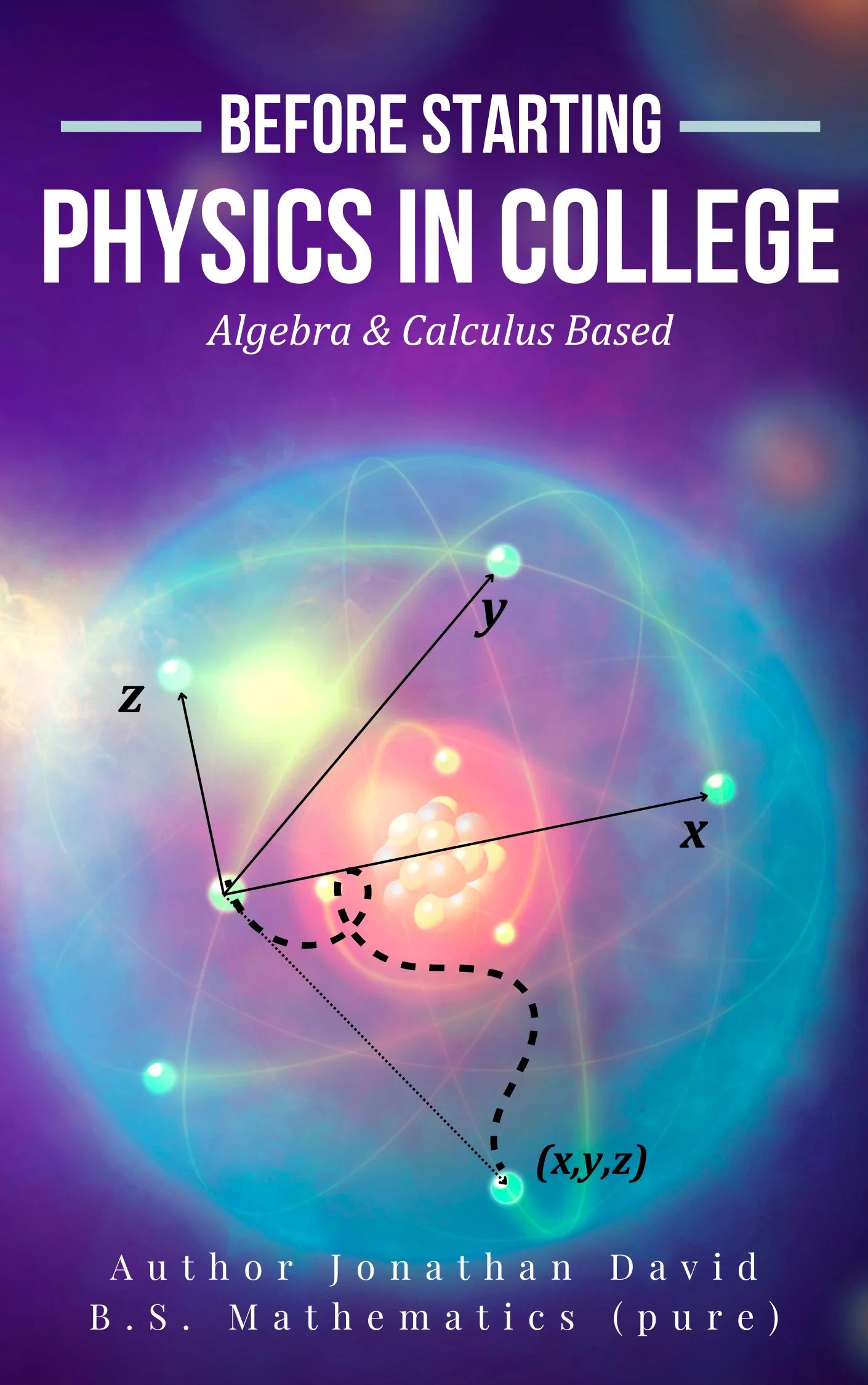
Inside Before Starting Physics — Study Advice, Math Review & Physics Problems

Look inside Before Starting Physics with Author Jonathan David. This walkthrough previews the guide’s study advice, discussion of algebra-based and calculus-based physics, mathematical preparation, and introductory problem-solving examples.


Watch the inside-the-book preview on YouTube ↗

Preparing to Begin—or Return to—Physics

Jonathan opens the guide and explains how it moves from study preparation and course expectations into mathematical notation and worked physics problems.

  • Study advice and common misconceptions about learning physics.
  • Discussion of algebra-based and calculus-based courses.
  • Selected algebra, trigonometry, and calculus preparation.
  • Problem-solving approaches and introductory physics examples.

Original Transcript (punctuated)

Based on the supplied transcript. Punctuation and paragraph breaks have been added, with repeated fillers and false starts reduced for readability. Unclear speech is marked where necessary. Product descriptions, estimates, and opinions remain the speaker’s.

Okay, kids. I’m going to show you a look inside the Before Starting Physics book. Did I download it? Basic Physics—no, I didn’t. Let me download it.

Before Starting Physics is right here.

Just so you know, if you purchase the Triple Play bundle for $99, you get access to around 900 videos of me writing these books.

For those saying, “You used AI,” no—there are about 600 videos of me writing the freaking book. My God.

The first half of Before Starting Physics is literature explaining studying physics and addressing misconceptions to straighten your thinking out.

I explain the differences between high school physics, college physics, and university physics—algebra-based versus calculus-based physics.

Then, around here, I show what you need from algebra, what you might need from trigonometry, and what you might need from calculus.

I go into how to approach problem solving. Here are more calculus-related things connected with what you’ll do.

Toward the end, we get into actual physics problems.

If you’re taking calculus-based physics, you’re not going to do much calculus, if any at all. I show the notation and how it works so it isn’t confusing.

That’s pretty much it. It isn’t a huge book. It’s about 80 textbook-sized pages, at least half written in mathematical code.

If you reduced it to a normal book size, it would be about 160 pages. If you expanded the code, it would be a fairly regular novel-sized book.

If you’re in college, about to begin, or returning to college, it isn’t a long read. It’ll change your life.

It documents what I went through and figured out, what I observed tutoring for 15 years, and what I saw when students used things like Khan Academy, AI, and private tutors and failed.

It’s intended to prevent that. If you’re serious about your education, this literature will reshape your thinking toward success.

That’s the response I’ve received from students who read the How to Study guide and Before Starting Physics. They say, “I’m ready to go. You’re right.”

The Ultimate Crash Course and The Ultimate Cheat Sheet are there to help ensure you understand what you need by junior year.

Cumulatively, it’s about 2,000 pages or something. I don’t know. And hundreds of videos—$99 for all that is a good deal.

I’d say about 900 recordings: around 300 podcasts and 600 or 700 video lessons.

It should be more expensive, but there isn’t a huge market, and interested college students often don’t have much money. I lowered the price significantly and put it into a bundle.

It’s a $99 one-time fee. You receive an access code to my work on this website, including the fiction.

Come to the front page. You can also go to—[unclear website name]—it’s the same thing. It’s $99 for the books and everything.

I tested the pricing, and it is what it is.

Some old cooking shows and other material are here, along with the fiction books. It’s worth the investment. You’ll be entertained and educated for a long time.

Enjoy. I’m moving on to the Math Monthly journal, doing math and physics every day with people and focusing on that.

If you want to develop your knowledge and prepare your résumé, joining the Math Monthly journal research program could be beneficial to your future and a lot of fun.

Thanks for watching. This is—[recording ends].

AI Summarization

Author Jonathan David provides an inside look at Before Starting Physics, describing its progression from study guidance to mathematical preparation and physics problem-solving examples.

Study Preparation

The opening portion discusses studying physics and addresses misconceptions Jonathan has observed through his own education and tutoring experience. The intended readers include students beginning college, current students, and adults returning to study.

Course Formats & Mathematical Background

The guide discusses algebra-based and calculus-based physics, then introduces selected material from algebra, trigonometry, and calculus. Jonathan emphasizes explaining notation so readers can approach the later examples with greater familiarity.

Problem-Solving Examples

Later sections move into approaches to problem solving and actual physics questions. The walkthrough presents the guide as a compact preparation resource rather than a comprehensive physics textbook.

The Broader Collection

Jonathan places the guide alongside the How to Study material, The Ultimate Crash Course, and The Ultimate Cheat Sheet. He also describes access to an accompanying library of lesson recordings, podcasts, and other work through the Triple Play bundle.

Continuing with Math Monthly

The video closes with Jonathan describing his shift toward the Math Monthly journal and collaborative mathematics and physics sessions. He presents participation as an opportunity to explore topics, develop skills, and contribute to the ongoing work.

Page counts, recording totals, and pricing are estimates or offers described in the recording. Consult the linked product pages for purchase details. The amount of calculus used in a physics course depends on its syllabus and level.

Books, PDF Bundle & Lesson Library

Explore my books and PDF bundle, which include access to a library of lessons.

Hardcover purchasers: Send me your purchase receipt to receive lesson library access.

Continue Exploring with Math Monthly

Explore mathematics, physics, and their connections to engineering with Author Jonathan David. Discover the available Math Monthly memberships and follow the development of new lessons and journal material.

View Math Monthly Memberships ↗

Membership Required

You must be a member to access this content.

View Membership Levels

Already a member? Log in here